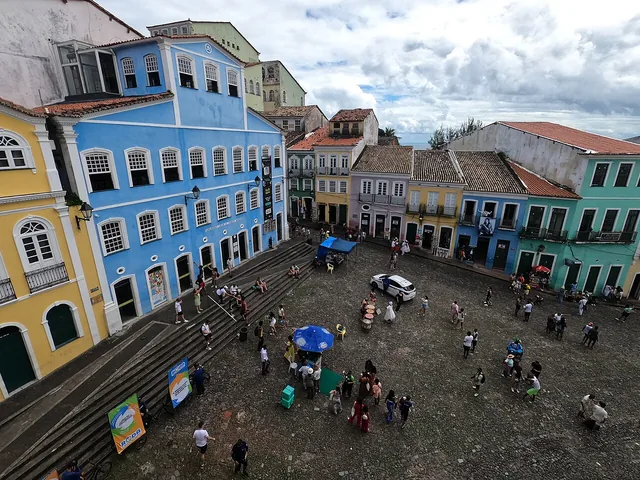
The streets and their memory
UNESCO’s account of the Historic Centre includes Salvador’s role as a colonial capital and a centre of the trade in enslaved people. The Upper Town gives that history a location. Its buildings record colonial power. The walk also needs to account for the people who built the city under coercion.
At Terreiro de Jesus, the Afro-Brazilian Museum (MAFRO) is in the historic Bahia medical school building. Taking the collection as a second chapter is an editorial choice that brings the city’s layout into conversation with histories of the diaspora.
From the square to the collection
Three settings call for different ways of approaching, observing and asking permission.
-
In public space
The street as a record
At Largo do Pelourinho, look at how the square meets the townhouses. Read the place name in the context of public punishment and enslavement as well as the architecture.
-
In the museum
One work, one reading
UFBA’s service directory documents 27 panels by Carybé depicting orixás. Consider the artist’s choices and read the museum’s interpretation. Check opening, access and available interpretation for your date.
-
With the community
A decision about welcoming visitors
Before visiting a terreiro, seek guidance from the community responsible for it. Confirm permission to enter, take part and make sound or image recordings separately.
While indoor access is pending, walk the public route between Terreiro de Jesus and Largo do Pelourinho, then read about the collection and the glossary.
Contextual glossaryKnowledge on the tabuleiro
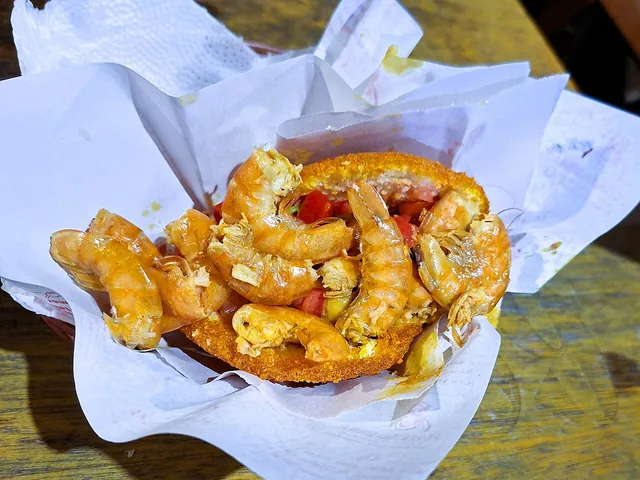
IPHAN’s dossier places Acarajé alongside the sale of baianas’ food, the use of dendê palm oil and connections to the worship of orixás. The register recognises acquired knowledge and a livelihood. Its 2022 revalidation broadened the territorial scope.
On the street, respect working time and ask people before taking photographs. For dietary requirements, ask about ingredients and preparation, including fillings and contact with shrimp.

Learning in the circle
IPHAN’s dossier treats the Roda de capoeira as a space for play and transmission of knowledge. Songs, instruments and movements make up the practice. The roda received Brazilian recognition in 2008 and entered UNESCO’s intangible heritage list in 2014.
A public roda can have its own rules for joining or recording. For a class, verify date, duration and language with the responsible group. The itinerary can remain a walk while a guided activity is pending.
What was recognised and when
The dates mark heritage decisions. The histories and transmission of these practices extend beyond the records.
-
The craft of the baianas de acarajé enters Brazil’s register of traditional knowledge. IPHAN
-
IPHAN registers the Capoeira Circle as a form of expression. IPHAN
-
UNESCO inscribes the Capoeira Circle on its intangible heritage list. Ministério da Cultura
-
Revalidation extends the scope of the baianas’ craft registration. IPHAN
-
IPHAN revalidates the circle and the craft of capoeira masters. IPHAN
Community and visits
IPHAN identifies Casa Branca, listed in 1984, as the first Candomblé Terreiro listed by the institute in Salvador. Heritage recognition gives context to religious communities in the city. The community decides whether to receive visitors or allow photographs.
A tourism offer about Candomblé has its own conditions. Ask who is responsible, which space is planned and what happens if the itinerary changes. A guided explanation of religion and participation in a ceremony are separate activities.
A visit in two parts
Begin at Largo Terreiro de Jesus and walk to Largo do Pelourinho. If MAFRO confirms opening and conditions for your group, allow a separate block inside. UFBA’s service directory describes steps in the historic building.
In Comércio, Cidade da Música da Bahia offers a way into the region’s musical expressions. Check the official programme and allow time to change levels. Use the readings and public outdoor spaces while indoor access is pending.
Contextual glossary
Acarajé
A black-eyed pea fritter fried in dendê palm oil. IPHAN documents the baianas’ craft as livelihood and religious knowledge. The Portuguese name is retained.
Roda de capoeira
A gathering in a circle where capoeira brings together play, song and instruments. The roda is a place for passing on knowledge. Schedules and participation depend on the organisers.
Terreiro
In this context, a place and community of Afro-Brazilian religious practice. Meaning varies with use. Terreiro de Jesus is the name of a public square in Salvador.
Candomblé
Afro-Brazilian religious traditions with diverse communities and forms of practice. We retain the Portuguese term. The community decides on reception and recording.
Pelourinho
The district’s name recalls a pillory, a post used for public punishment and associated with slavery. The capitalised word in this guide names the place. The Historic Centre covers a wider area.
Sources consulted
- UNESCO · Historic Centre of Salvador de Bahia
- UFBA · Carta de Serviços da UFBA · MAFRO
- Visit Salvador da Bahia · Uma saudade chamada Pelourinho · contexto do lugar
- IPHAN · Registro do Ofício das Baianas de Acarajé
- IPHAN · Dossiê do Ofício das Baianas de Acarajé
- IPHAN · Dossiê da Roda de Capoeira e Ofício dos Mestres
- Ministério da Cultura · Roda de Capoeira: patrimônio cultural
- IPHAN · Terreiro da Casa Branca e proteção do entorno
- Civitatis · Candomblé tour
- Visit Salvador da Bahia · Cidade da Música da Bahia
Consulted on · .
AI assisted the research and writing for this guide.